Back to projects
Energy Systems AnalysisCompleted Technical Study

Ikogosi Mini-Grid - Anchor-Load Shifting & HOMER Pro Optimization

Integrated demand-modelling and techno-economic assessment of the Ikogosi community mini-grid. The study combined an Odyssey-derived 8,760-hour load profile, Python-based demand validation and visualization, strategic modelling of major anchor loads within the daytime solar window, and HOMER Pro simulation of a PV-BESS-diesel-grid hybrid architecture.

Ikogosi Mini-Grid - Anchor-Load Shifting & HOMER Pro Optimization project visual

Project image

Location

Ikogosi, Ekiti, Nigeria

Period

2026

01 / Scope of Work

Work modelled, designed or delivered.

  1. 01

    Reviewed the Odyssey-derived annual demand model covering residential, commercial, productive-use and major anchor loads.

  2. 02

    Modelled major anchor demand within the daytime solar-generation window to evaluate the effect of load shifting on PV utilization and battery-storage requirements.

  3. 03

    Validated the 8,760-hour annual community load profile in Python and checked timestamps, missing values and total system demand.

  4. 04

    Calculated annual demand indicators including peak load, minimum demand, average demand, annual energy and load factor.

  5. 05

    Developed annual load-profile, average 24-hour demand and load-duration-curve visualizations.

  6. 06

    Configured and evaluated PV, battery storage, diesel generation, converter and grid-support components in HOMER Pro.

  7. 07

    Assessed system energy production, generator operation, excess electricity, unmet load and lifecycle economics.

  8. 08

    Reviewed a client-facing optimized simulation case and compared technical and economic performance.
02 / Results & Findings

Results from the project work.

  1. 01

    Validated all 8,760 hourly community-demand records with no missing system-load values.

    Modelled result

  2. 02

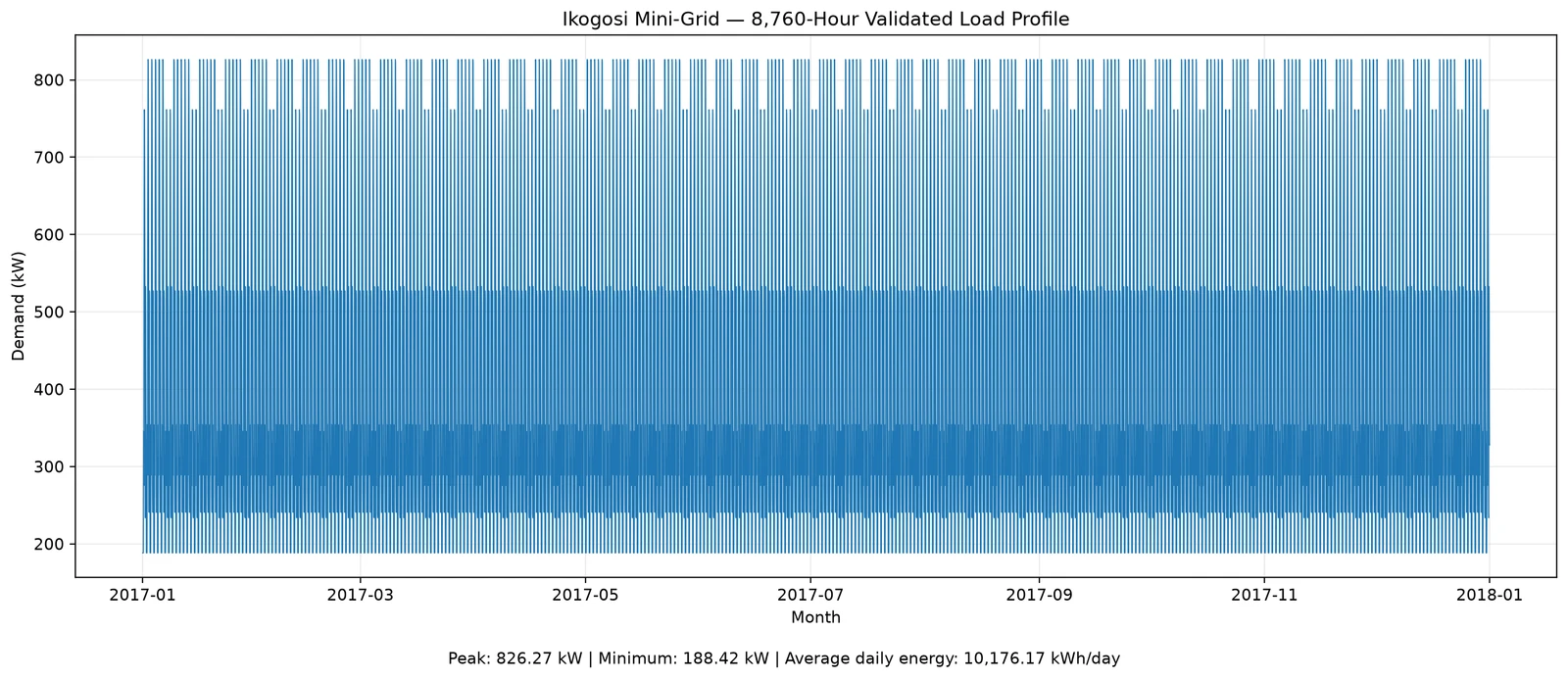
    Calculated a peak demand of approximately 826.27 kW occurring around 11:00, reflecting the modelled daytime concentration of major anchor demand.

    Modelled result

  3. 03

    Calculated an average demand of approximately 424.01 kW, average daily energy consumption of 10,176.17 kWh/day and annual energy demand of approximately 3.714 GWh.

    Modelled result

  4. 04

    Calculated a system load factor of 51.32%.

    Modelled result

  5. 05

    Evaluated a HOMER engineering configuration comprising 2.5 MW of PV, approximately 5.1 MWh of battery storage, a 1.08 MW diesel generator and an 800 kW system converter.

    Modelled result

  6. 06

    The engineering simulation reported zero unmet electric load and zero capacity shortage under the modelled conditions.

    Modelled result

  7. 07

    Annual production in the engineering case was approximately 81.7% PV, 15.4% diesel generation and 2.94% grid purchases.

    Modelled result

  8. 08

    The engineering simulation produced a total net present cost of approximately $4.46 million and a levelized cost of energy of $0.126/kWh under the modelled assumptions.

    Modelled result

Ikogosi / Modelled demand & HOMER study

Demand shape & hybrid supply.

Explore the average daily demand and the selected system’s annual energy sources.

Explore the study Close study

Daily demand shape

Follow anchor and community demand.

8,760 modelled hoursAnnual peak 826.3 kW

Follow anchor and community demand.Annual average by hour of day. Total demand, Anchor loads, Community loads. Units: kW / average hour. Exact values for every sample are in the study data table below.0250500750100000:0004:0008:0012:0015:0019:0023:00kW / average hour

Select a sample or point to the chart to inspect it.

Engineering decision

Assess the daytime anchor demand alongside community demand when considering solar alignment and dispatchable supply.

Published demand profileView source
Model assumptions & limits
  • Each point averages the same hour over all 365 days of the modelled 8,760-hour profile. Input load values are already in kW.
  • The CSV uses a 2017 reference calendar. It is a modelled demand profile, not a record of measurements taken in 2017.
  • An average day smooths seasonal and day-to-day peaks. The annual peak shown above is from the complete profile, not the average-day curve.
  • Anchor loads are summed together; community demand combines residential, commercial, productive and public loads. No unshifted baseline was supplied, so this does not claim a before-and-after improvement.
View study data
Annual average by hour of day
SampleTotal demand (kW)Anchor loads (kW)Community loads (kW)
00:00188.47.5180.9
01:00188.47.5180.9
02:00188.47.5180.9
03:00188.47.5180.9
04:00188.47.5180.9
05:00266.57.5259.0
06:00351.814.6337.2
07:00285.047.2237.8
08:00422.1225.5196.6
09:00623.7399.1224.6
10:00740.9507.7233.2
11:00807.6552.7254.9
12:00803.3549.1254.2
13:00746.0504.8241.2
14:00642.5401.3241.2
15:00561.0322.0239.0
16:00263.061.9201.1
17:00238.818.3220.5
18:00431.211.8419.4
19:00528.811.2517.6
20:00512.911.2501.7
21:00375.311.2364.2
22:00318.37.5310.8
23:00315.57.5308.0

Annual energy sources

See where the modelled energy comes from.

3,714.562 MWh servedReported unmet load: 0

See where the modelled energy comes from.Reported annual production. Annual production. Units: MWh / year. Exact values for every sample are in the study data table below.01000200030004000Solar PVDieselGrid purchasesMWh / year

Select a sample or point to the chart to inspect it.

Engineering decision

Read the production mix alongside served demand, excess generation and storage losses when assessing the selected hybrid architecture.

HOMER engineering reportPage 6
Model assumptions & limits
  • Annual source production totals 4,222.18 MWh. The report records 319.058 MWh of excess electricity.
  • Production share is a share of generated and purchased energy, not the renewable fraction of energy served. Storage and conversion losses separate production from consumption.
  • Served energy includes 3,386.324 MWh of AC primary load and 328.238 MWh of deferrable load.
  • These are annual HOMER results for the selected configuration, not measured operating performance or an hourly dispatch forecast.
View study data
Reported annual production
SampleAnnual production (MWh)Production share (%)
Solar PV3,448.781.7
Diesel649.515.4
Grid purchases124.02.9

Sites & Work Packages

Work covered by each site.

Site-level scope recorded for this assignment.

01

Anchor-Load & Demand Modelling

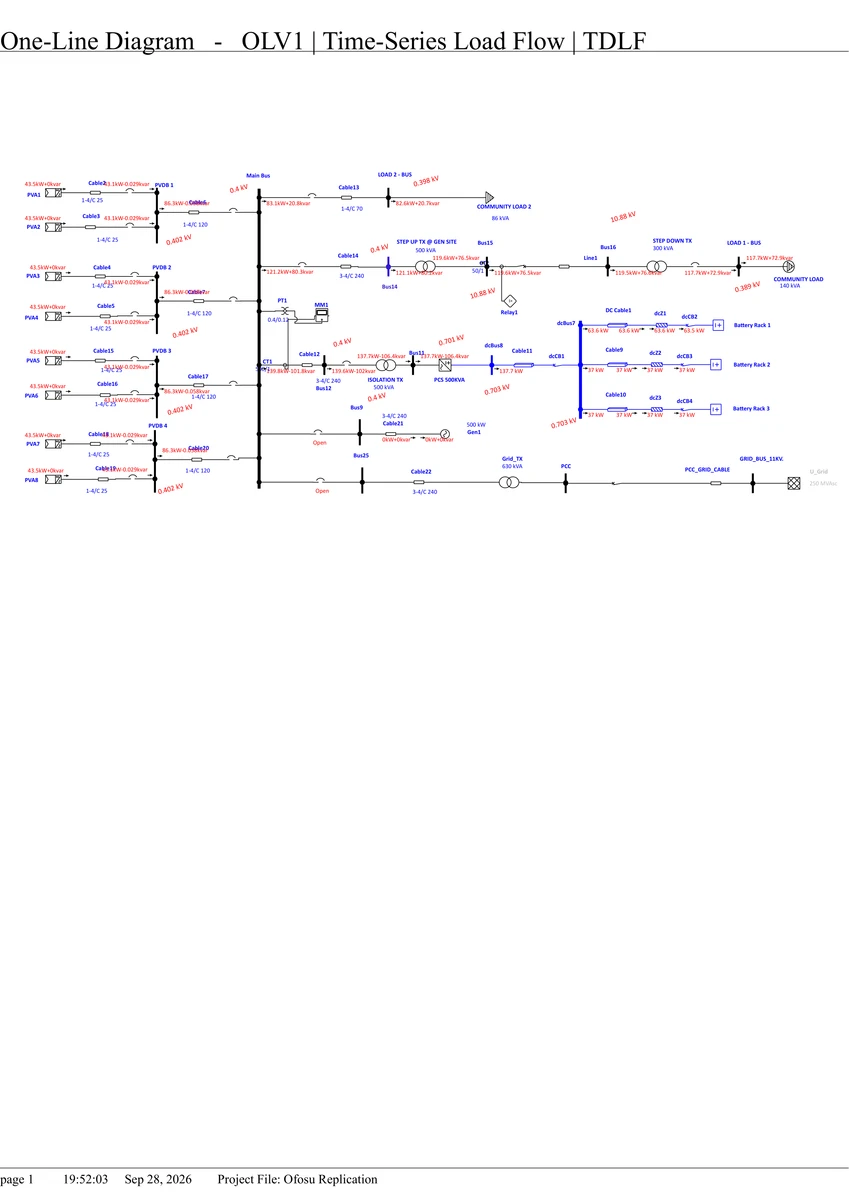
Modelled community and major anchor demand with deliberate daytime load placement to evaluate stronger alignment between demand and solar production.

02

Python Load Analysis

Validated the 8,760-hour dataset and quantified peak demand, energy consumption, load factor and demand-duration characteristics.

03

Hybrid System Optimization

Evaluated PV, BESS, diesel generation, converter and grid-support configurations in HOMER Pro for reliability and lifecycle economics.

Project Evidence

Supporting project records.

Available for Ikogosi Mini-Grid - Anchor-Load Shifting & HOMER Pro Optimization: Engineering Drawings · Reports / PDFs. Open an image for a closer view or select a document to read it.

01

Engineering Drawings

3 items

02

Reports / PDFs

3 items

PDF

Reports / PDFs

Case 1 - Odyssey Anchor-Load Assessment

Demand-modelling assessment documenting the community profile and the strategic treatment of major anchor loads within the daytime solar window.

Jun 2026

View document
PDF

Reports / PDFs

Case 2 - HOMER Pro Engineering Simulation

Detailed HOMER Pro engineering simulation covering system architecture, PV generation, battery storage, diesel generation, grid support and lifecycle performance.

Jun 2026

View document
PDF

Reports / PDFs

Case 3 - HOMER Pro Client Optimization

Client-facing hybrid-system simulation presenting the proposed system configuration and associated technical and financial indicators.

Jun 2026

View document

Related Engineering Work

Related projects.

Other case studies that use related engineering tools and methods.

More Case Studies

Compare this study with the other mini-grid, distribution and power-system projects.